The MER Trap: Why Your Best ROAS Days Might Be Killing Your Cash Flow
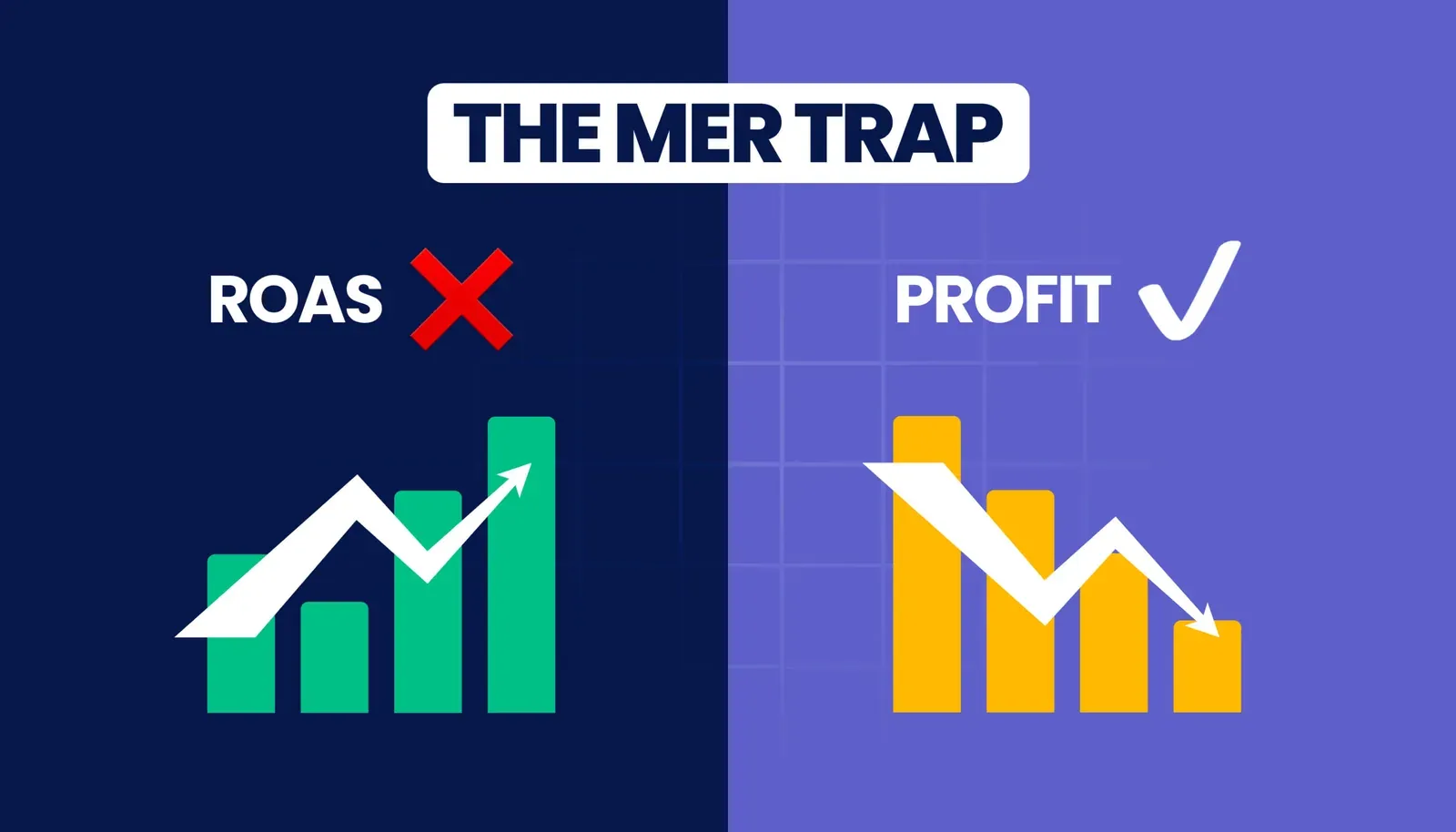
The ROAS Illusion: High platform ROAS often masks “cannibalized” organic sales, leading to lower actual profit.
2 min read
Key Takeaways
-
The ROAS Illusion: High platform ROAS often masks “cannibalized” organic sales, leading to lower actual profit.
-
MER vs. iROAS: Marketing Efficiency Ratio (MER) provides the macro view, while Incremental ROAS (iROAS) proves if your ads are actually driving new growth.
-
The Scale Paradox: Scaling spend to chase ROAS targets often leads to a “Contribution Margin” collapse.
1. The False Comfort of Dashboard Metrics
In the 2026 performance landscape, the most dangerous place to look for truth is inside a single ad manager. We’ve entered the era of the “Platform Paradox”: as Meta and Google’s AI (Advantage+ and PMax) become more efficient at finding “likely buyers,” they often prioritize users who were already on the verge of purchasing.
The result? A staggering 4.5x ROAS on your dashboard, while your bank account shows stagnant net revenue. This is the MER Trap. If you scale based on platform ROAS alone, you risk overpaying for customers you would have acquired for free through organic search or direct traffic.
2. Defining the North Star: MER vs. iROAS
To escape the trap, high-growth brands are shifting their North Star metric from ROAS to a combination of Marketing Efficiency Ratio (MER) and Incremental ROAS (iROAS).
| Metric | Calculation | The “Birch” Perspective |
| ROAS | Ad Revenue / Ad Spend | A platform-specific health check, not a business metric. |
| MER | Total Revenue / Total Ad Spend | The “CFO’s View”—measures the total pressure ads put on the business. |
| iROAS | (Total Rev. – Baseline Rev.) / Ad Spend | The “Truth Metric”—did this ad actually create a sale that wouldn’t have happened? |
3. The “Contribution Margin” Collapse
Every product has a “Scaling Ceiling.” As you push budgets higher to maintain a specific ROAS, your Customer Acquisition Cost (CAC) eventually intersects with your Contribution Margin.
At this intersection, every new dollar spent on ads actually decreases your total profit, even if the ROAS looks stable. Strategic media buying in 2026 requires a “Profit-First” feedback loop. You must know your “Break-even MER”—the point where your total marketing spend as a percentage of total revenue allows for a healthy bottom line.
Expert Tip: If your MER is improving while your ROAS is dropping, you are likely seeing a “Halo Effect” where your ads are driving high-value organic discovery. This is a signal to scale, not to cut.
Key Takeaways
-
Stop chasing “Ghost ROAS”: Always verify platform wins against total revenue growth.
-
Identify your Break-even MER: Know the exact percentage of revenue you can afford to spend on ads before profit disappears.
-
Test for Incrementality: Occasionally “darken” specific regions or audiences to see if organic sales drop. If they don’t, your ads weren’t incremental.
-
Centralize Reporting: Use tools like Rockads to bridge the gap between media buying and business intelligence.
Keep reading
All posts


This is the part
we actually fix.
Ad accounts, funding, policy cover and the day-to-day running of it. Tell us the platforms and the markets you need.
- Same business day response
- No lock-in period